At the 2026 Met Gala, Fashion Didn't Just Reference Art—It Became It
The Costume Institute's new exhibition, Costume Art, aims to answer that question, and the red carpet served as a nice support.

Jalil Johnson is a Who What Wear editor in residence and New York–based writer, fashion authority, and media personality who began his career as a stylist and later spent three years at Saks Fifth Avenue refining his eye for trend reporting, emerging talent, and brand storytelling. He now brings his expertise to his newsletter, Consider Yourself Cultured, and has also been featured in The New York Times, Harper's Bazaar, The Wall Street Journal, and The Financial Times, and Vogue named him one of the "New Faces of Street Style."
There has long been a debate over whether or not fashion can be considered art. In fact, while playing a rousing game of trivia at the Instagram Met Gala watch party hosted at the Mark Hotel, I was reminded of something Karl Lagerfeld said in the documentary The First Monday in May: "What we do is applied art. Chanel never said she was an artist. She was a dressmaker. Madam Vionnet was a dressmaker. Madam Lanvin was a dressmaker. They wanted to dress a certain kind of society, and they were happy and flattered when those women bought those dresses."
Inside the Exhibition

This year, however, the Met's Costume Institute's spring exhibition, Costume Art, attempts to push that conversation forward, reframing the question of whether fashion can be considered an art form or, in the words of Lagerfeld, an "applied art."

At the press preview, Andrew Bolton, the Wendy Yu curator in charge of the Costume Institute, stated, "It implores us to see the dressed body as not only an object of representation but as a subject of experience, a medium in which the medium of art can be reimagined." Costume Art, the inaugural exhibition in the Condé M. Nast Galleries, encourages visitors to move beyond seeing fashion as a vehicle for art and instead understand fashion and art as working in tandem.

It reinforces not only what Met Gala honorary chair Lauren Sánchez Bezos declared at the preview ("The Met has always understood something the world is finally catching up to—fashion is art") but also asks viewers to consider fashion as the medium we engage with daily to perform the ultimate act of art, be it applied or performance: living. As Bolton went on to say, "Fashion isn't only something we see. It's something we wear. It shapes posture, gesture, presence, and perception. In wearing clothes, we don't simply express who we are. We become who we are, which makes fashion different from any other art form. It collapses the boundary between subject and object."

The exhibition itself comprises nearly 400 items from the Met's collection, and fashion is placed in dialogue with artwork spanning centuries, creating connections that range from the literal to the conceptual. These works are organized into a series of thematic categories, all tied to the body. Among them is Classical Body, which is rooted in Hellenic and Roman studies of form, featuring a molded, armor-like gold minidress from Givenchy designed by Alexander McQueen alongside more fluid, draped pieces that echo the softness of classical sculpture, like a Di Petsa dress that appears as though the wearer arrived straight from a wet T-shirt contest.

Pregnant Body examines maternalwear through the ages, including a Charles James taffeta dinner suit designed as part of a maternity line for Lane Bryant Inc. in 1954, serving as both a counterpoint to the classical ideal and a reclamation of it. Epidermal Body and Inscribed Body explore fashion that mimics or evokes skin, reinforcing the idea of clothing as a second skin, from a Schiaparelli dress by Daniel Roseberry with the appearance of peeling flesh to Adriana Varejão's "Parede com Incisões à la Fontana—Horizontal" and Jean Paul Gaultier's mesh tattooed pieces, two of which are included in the exhibition.

Ashley Graham wearing Di Petsa to the 2026 Met Gala
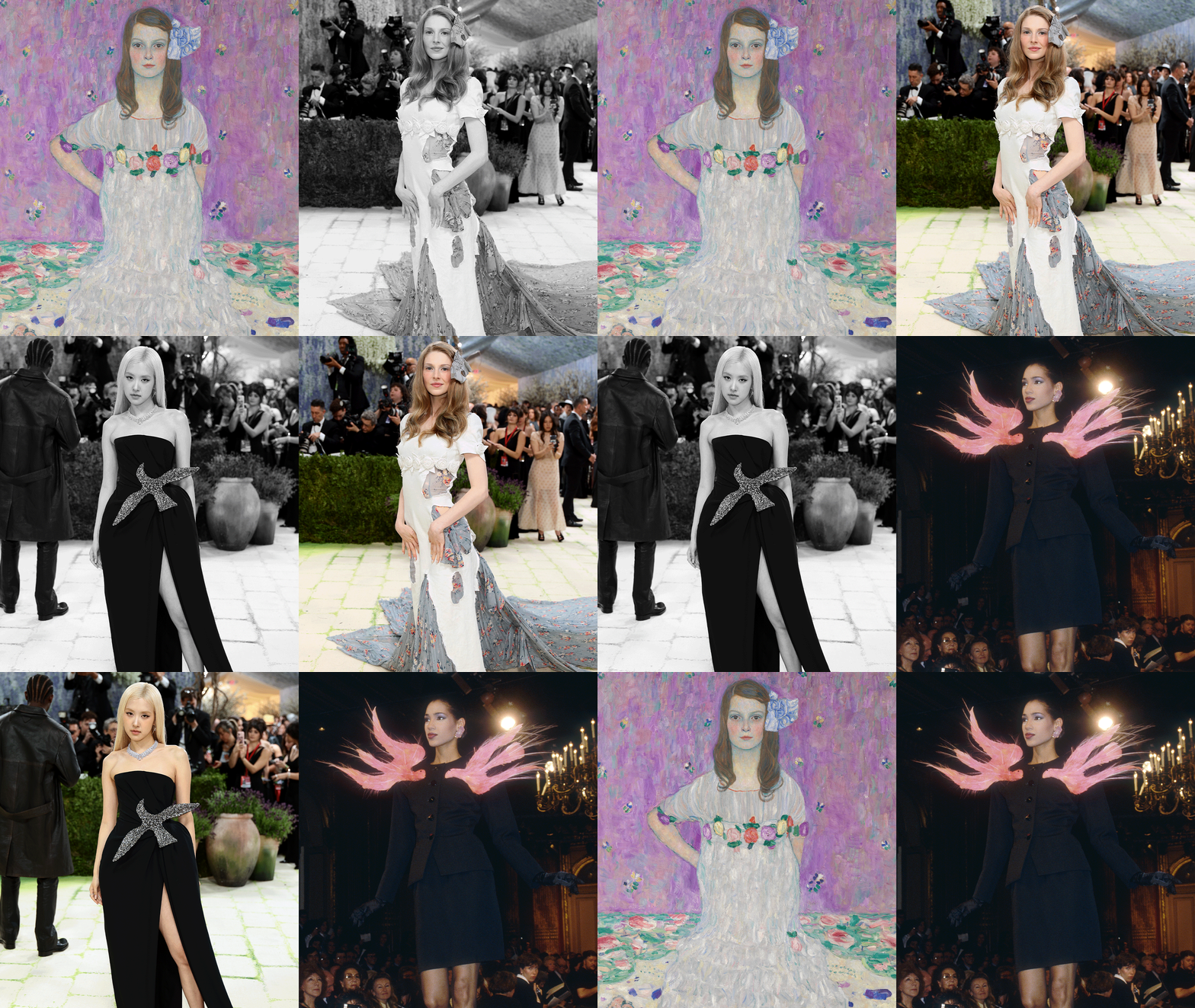
Though the exhibition undoubtedly sets the tone for what appears on the carpet, the official gala dress code, Fashion Is Art, gave attendees permission to interpret the idea on their own terms. Some leaned quite literal. Hunter Schafer arrived in Prada inspired by Gustav Klimt's "Mäda Primavesi," and Colman Domingo, in Valentino by Alessandro Michele, called to mind Pablo Picasso's "Acrobat and Young Harlequin." Amy Sherald, in Thom Browne, appeared as if she had stepped directly out of one of her own paintings, "Miss Everything (Unsuppressed Deliverance)."
The Red Carpet as Interpretation

Hunter Schafer at the Met Gala 2026 in a Prada look inspired by Gustav Klimt's "Mäda Primavesi"

Colman Domingo at the Met Gala 2026 in a Valentino look reminiscent of Picasso

Amy Sherald at the Met Gala 2026 in a Thom Browne look reminiscent of one of her own paintings, "Miss Everything (Unsuppressed Deliverance)."
Others took a more abstract approach. Nicole Kidman's red Chanel dress read less as reference and more as interpretation, channeling the emotional and historical weight of the color itself.

Nicole Kidman in Chanel at Met Gala 2026
There was also Sabrina Carpenter in Dior, paying homage to the film Sabrina with actual film reels forming the bodice and film stills set as the central jewels of her flapper-esque headpiece.

Sabrina Carpenter in Dior at Met Gala 2026
In terms of standout houses, Saint Laurent, one of the evening's sponsors, turned inward, revisiting its own history with art by re-creating the famed golden cast for Hailey Bieber, originally produced in collaboration with Claude Lalanne for the A/W 69/70 haute couture collection.

Hailey Bieber in archive-inspired Saint Laurent at the Met Gala 2026

Saint Laurent A/W 69/70
Singer Rosé wore a pared-back black dress punctuated with birds in the style of Henri Matisse's "The Birds," a subtle but pointed callback to the house's S/S 88 collection.

Rosé in archive-inspired Saint Laurent at the Met Gala 2026

Saint Laurent S/S 88
Another strong showing came from emerging designer Robert Wun, who dressed Jordan Roth, Naomi Osaka, and Beyoncé, the latter wearing the designer inside the Met during the evening's programming.

Beyoncé wearing Robert Wun for her second look at Met Gala 2026

Naomi Osaka in Robert Wun at Met Gala 2026

Jordan Roth in Robert Wun at Met Gala 2026
Still, the most pervasive reference point of the night may have been the Hellenic and Roman statues that continue to shape our visual language around the body. Their influence appeared everywhere, from Sombr in Valentino to Serena Williams in a battle-ready silver draped gown by Marc Jacobs and, most overtly, Heidi Klum, who arrived as a literal statue, gray-faced and all, really driving home the point that fashion is art.

Heidi Klum at the Met Gala 2026 in a look inspired by Raffaele Monti's "Veiled Vestal"

Sombr in Valentino at the Met Gala 2026

Serena Williams in Marc Jacobs at the Met Gala 2026
