
It’s easy to assume Erin Kellyman would have a loud personality, owing to her striking hair and freckles that beg to be stared at. But she actually carries a calming presence that makes her beauty the least interesting thing about her. When we meet at 8 pm via Zoom on a Wednesday night, she sits fresh-faced with her hair in twists following a gruelling schedule of press junkets and photoshoots for two blockbuster films: Eleanor the Great and 28 Years Later: The Bone Temple, in both of which she stars as the lead actress. And whilst you’d expect her mind to be running at a million miles an hour, she simply reassures me that it’s just a busy week before some time off. It sets the tone for an hour of getting to know Kellyman, who possesses a grace that feels less like a personality trait and more like her foundation.

Partly out of my own fascination with identity, I ask Kellyman what it was like growing up with mixed Afro-Caribbean-Irish heritage and how this played a part in who she is today. "I think my identity has been a massive part of my life," she says, lingering on the thought a little longer. "I didn't see a lot of representation on screen." It’s clear that she's impassioned by a front-facing career to help bridge that gap. "I'm proud of myself, and I'm happy that I [can] maybe be a role model for mixed kids who don't feel like they fit in, whether in social situations or with different sides of their family."

Curious to understand her and how she grew up, I ask more about her childhood and whether she always knew she wanted to perform. "I still don't know if I want to perform," she admits. "I don't even feel like I do that. When I'm acting, it doesn't feel like performing. I was constantly watching people and observing how they interact. I was really, really quiet, so I would just watch people all the time."
Barely 10 minutes into our conversation, I have an early "aha" moment. "I’m not a huge movie buff," she admits, "which is again very contradictory to the industry that I'm in. I love to watch a good movie, but growing up, it was documentary after documentary, and hours on YouTube." It makes sense to me that Kellyman would be a documentary kid; from the outset, she seems curious, observant and attuned to people’s subtleties. It tracks perfectly with the quiet watchfulness she’s described. But I’m curious about the leap; if documentaries shaped her, why choose the fictional world? Why act rather than document?
She thinks about it for a moment before explaining that, as a child, fiction was her real home. Many of her memories are of playing pretend, stepping into characters she created. Teachers would describe her as "away with the fairies"; a gentle dismissal she now reframes. "I wasn’t really away with the fairies," she says. "I had a whole dialogue going on up here, like a four-part movie running in my head." Suddenly, it becomes obvious that documentaries fed her fascination with people, whilst fiction gave her permission to become them.

Her path into acting wasn’t linear. It was her older sister, the first in the family to try performing, who led her mother to the Nottingham Television Workshop, which Kellyman eventually joined at 13. Before then, she’d resisted it completely. "My mum would say, 'I’m taking your sister anyway, do you want to join?' and I couldn’t think of anything worse." She talks about her mum enrolling them in every class imaginable, and I feel a shared connection as we laugh about how we both grew up with mothers who saw activities as opportunities: ballet, swimming, dance—anything that might spark a passion.

Kellyman plays Jimmy Ink in the latest instalment of the 28 Days Later franchise, 28 Years Later: The Bone Temple, which is set to be released in January 2026. I explain how I found the character both likeable and unlikeable in equal measure, and she lights up, as she tells me she never wanted Jimmy to feel linear. As for choosing roles, she simply follows what moves her. "I just want to play people I’m excited by," she says. She credits Jack O'Connell, who plays alongside her in the blockbuster (and in the previous film in the series, 28 Years Later), as having helped shape her craft, not because of his profile, but because they share the same roots, both having trained at the Nottingham Television Workshop.
"That place is a masterclass," she says. "It strips everything back. It’s so real." Being on set with O'Connell reminded her of that rawness, that instinctive way of working that she grew up with. She continues with so much pride that her face beams. "That’s a workshopper," she says, smiling. And it's a title she holds with great pride. "If you get into TV Workshop, you’re officially a workshopper. No matter how big my career gets, I’ll always be a workshopper first."


It’s rare to hear someone speak about their training with that kind of devotion, almost like an alma mater, and it makes sense that the improvisation and instinct are baked into her. It's as if being a "workshopper" didn’t just teach her how to act; it made her the kind of actor she is.
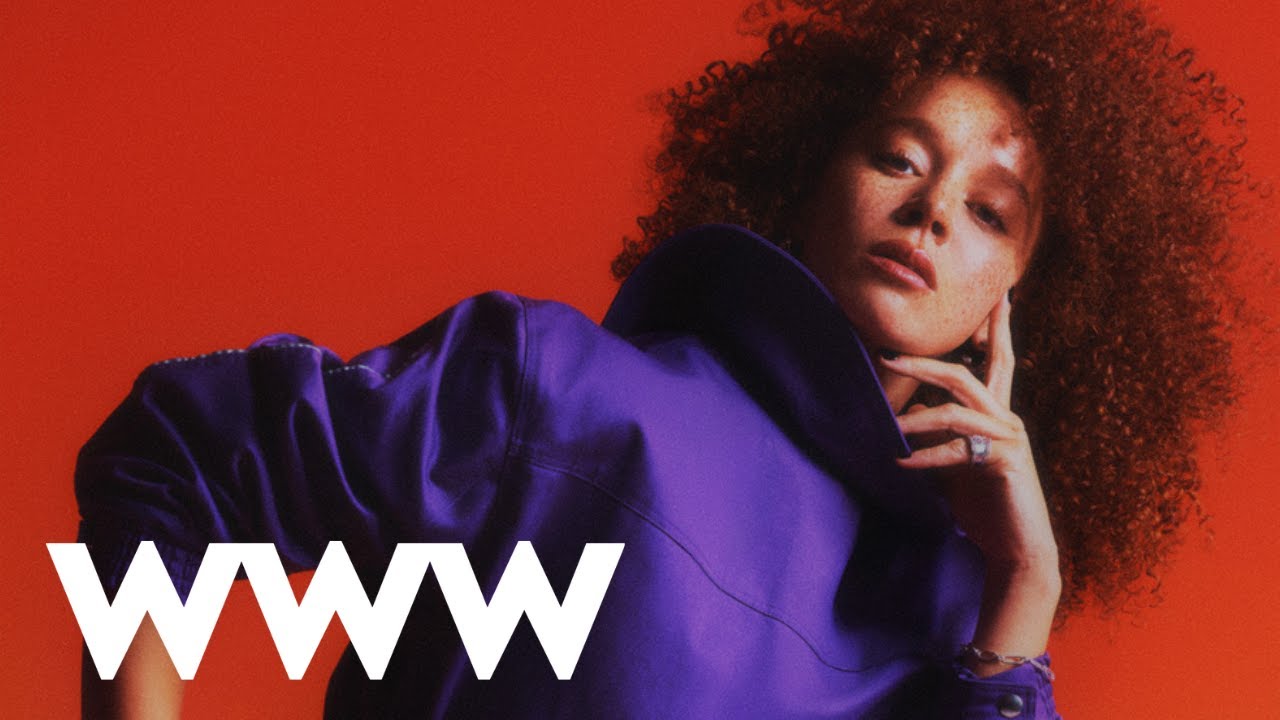
When I ask what drew her to Eleanor the Great, she talks of her character Nina’s quietness, "I was such an anxious kid, I could barely hold a conversation with anybody, she shares, "But by the end of the film, [Nina] comes into her own, and I really related to that." I tell her how striking that parallel is: the girl who once couldn’t look people in the eye is now leading major movies and on the cover of magazines. We giggle together as she talks about how surreal it is to connect those dots.

She tells me she would have loved to play Villanelle in hit BBC series Killing Eve, portrayed by another of her 28 Years Later co-stars, Jodie Comer. Listening to her, I realise there’s a thread running through the roles she gravitates towards. She’s drawn to complicated people, the ones who don’t make sense at first glance. There’s something in her—the observer, the former documentary kid—that wants to understand them. It’s almost as if she chooses characters she can’t quite figure out, and the work becomes the process of decoding them.


She cites Meryl Streep, Julie Walters and Saoirse Ronan as actors she looks up to, then it dawns on me that both films she's currently promoting are directed by women. I ask her what feels different about working with female directors. "There's an unspoken energy that I think comes with being surrounded by women. You just feel inherently understood," she says. I smile in agreement as the director in me connects to her explanation. "It's like sipping a cup of tea after a long day—you just feel calm." I reply, “You exhale." "Exactly," she says.

As our chat draws to a close, we giggle at her newfound fashion status. How does it feel to be a cover star for a fashion title? Kellyman laughs. "It doesn’t feel real. I feel like I’ve snuck in and no one’s noticed." Her upbringing was anything but fashion-focused. "We got the odd new thing for Christmas, but mostly it was whatever was passed down," she tells me. Now, though, her relationship with fashion is growing, and her favourite designers—Miu Miu, Gucci, Simone Rocha—make perfect sense; labels that blend characteristics in playful, unexpected ways and are a little complicated and harder to define, exactly like the characters she loves.
She admits that she may be drawn to a bit of chaos, and that this shows up in her taste in fashion, in the colours, the contrasts, the unexpected pairings. On our shoot, it was the Gucci suit and red Simone Rocha dress that made her feel most herself. "I just felt good in them," she says, and it's fitting that the anxious kid in hand-me-downs is now standing fully inside looks that carry the same contradictions as she does.

I’m struck by how quietly expansive Kellyman is. Nothing about her is linear, not her characters, not her instincts, not even the way she sees herself. And at just 27, she carries a softness that’s constantly in dialogue with something deeper, stranger, more complicated. And yet, she wears it all lightly. There’s no performance, rather just a young woman figuring herself out in real time, pulling at the threads of curiosity she uncovers. I have a sense that whatever she does next, she’ll meet it the same way she meets everything; with instinct and the kind of emotional intelligence you can’t teach. She's a true workshopper at heart—still observing, still transforming and most of all, still becoming.

Photographer: Florence Mann
Stylist: Sophie Robyn Watson
Hair Stylist: Nicola Harrowell at Premier
Makeup Artist: Kenneth Soh at The Wall Group
Manicurist: Charly Avenell using Manucurist
Managing Director: Hannah Almassi
Art Director: Natalia Sztyk
Set Designer: Penny Mills
Set Assistant: Tilly-Rose Evans
Executive Director, Entertainment: Jessica Baker
Editor: Basma Khalifa
Video: Natasha Wilson
Photography Assistant: Georgia Williams, Ruby Griffith
Digital Technician: Marija Vainilaviciute
Styling Assistant: Mariya Bhad
Production: Town Productions