Meet Jérôme Epinette, the Nose Who Can't Stop Going Viral
The master perfumer has a talent for knowing what people want to wear next.

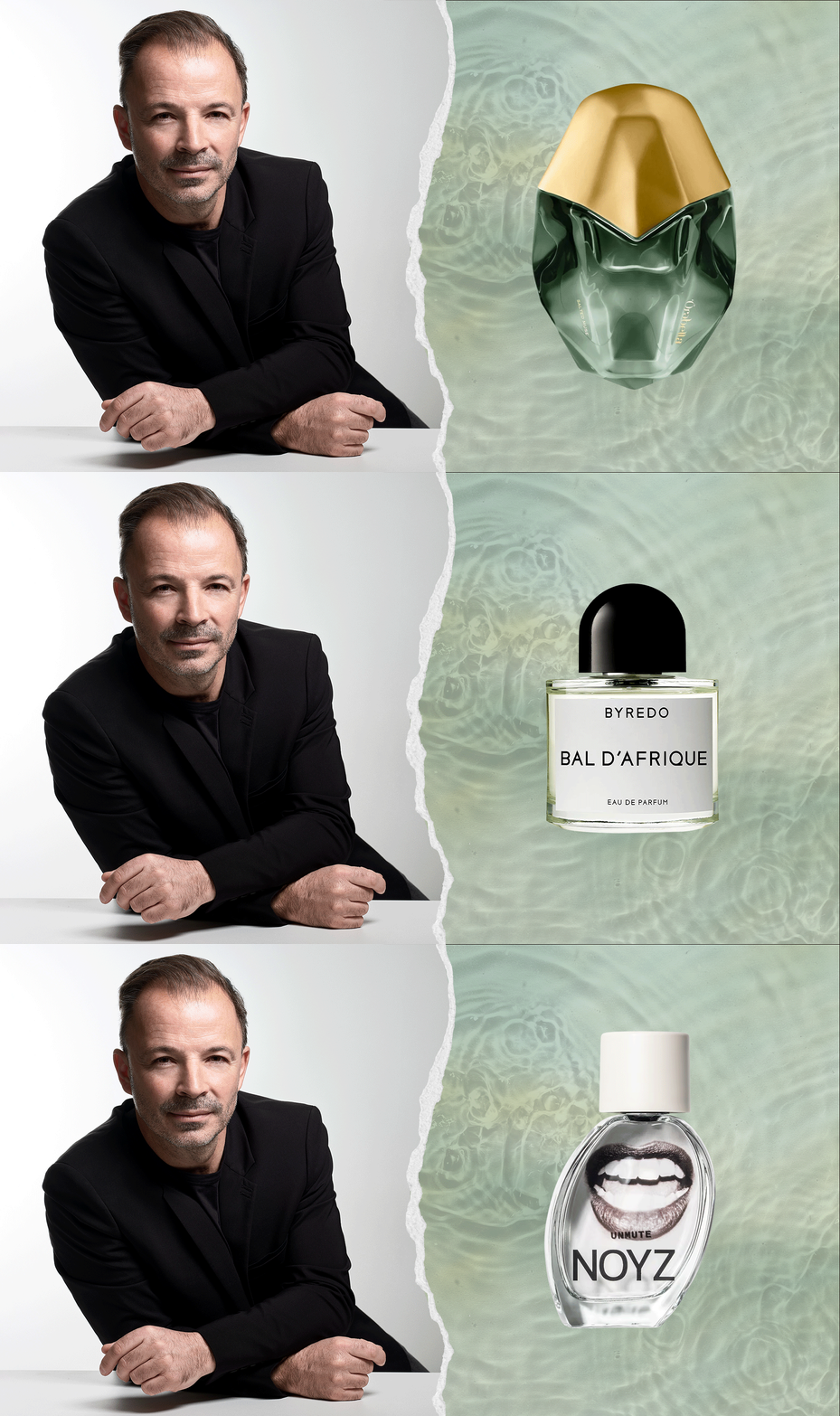
A master perfumer is like a unicorn. There are thought to be fewer than 600 professionally trained noses in the entire world—fewer than the number of astronauts—and they're as enigmatic as they are scarce. Invisible art, after all, requires some sacred alchemy. Techniques are guarded like trade secrets, and thus the experts behind them have historically stayed out of the spotlight, conjuring their magic without so much as a nod from the public. Today, thanks to the explosion of #PerfumeTok and the consumer demand for authenticity, a group of "celebrity noses" has emerged from anonymity and become bigwigs in their own right. Jérôme Epinette is one of those "IYKYK" household names—and he just might have the Midas touch.
Growing up in Burgundy, France, with sprawling vineyards as his playground, Epinette was destined to work with scent in some regard. "My mother owned several fragrance boutiques, so I was introduced to perfume at a very young age," he shares. "Some of my earliest memories are from spending time in [there], smelling different fragrances and trying to identify the ingredients. I was fascinated by how different notes came together to create something entirely new." That instinct served him well as he went on to earn a master's degree in biochemistry from Burgundy University and study at the prestigious Grasse Institute of Perfumery, which accepts no more than 12 (yes, 12!) students per year.
Upon graduating in 2002, Epinette joined French fragrance company Robertet and, a few years later, moved to the States to open its New York location. A "major turning point" for the master perfumer, he credits that move with pushing the boundaries of craft. "[It] gave me the opportunity to explore a more creative and unconventional approach to perfumery," he explains. Enter Byredo's Bal d'Afrique, which arguably became Epinette's first viral hit. He continued to create other buzzy sensations (Sol de Janeiro's Cheirosa 62, Victoria Beckham Beauty's Portofino '97, Ariana Grande’s God Is a Woman, I could go on), but still, that bright, woody blend of bergamot, African marigold, violet, cedarwood, and vetiver will forever hold a piece of his heart.


"Bal d'Afrique is certainly one I'm very proud of. It has such a distinct identity, and seeing it continue to connect with people after so many years is incredibly rewarding," he shares. "You can recognize when you've created something you're really happy with, but you can never predict how successful it will become." Epinette swears he doesn't have a secret sauce for virality ("I try to focus on creating the best fragrance possible rather than thinking about whether it will be a hit," he answers), but picking his brain on trends is as close as it comes to putting together a recipe. Here, find his unfiltered musings on the current scent landscape: what's in, what's out, and what's bound to take off in the year ahead.

When creating a fragrance, it's only natural to want as many people as possible to fall in love with the juice. Epinette, however, doesn't approach his creative process with the hope of launching the next best seller—even if he is responsible for quite a few commercial hits. (Old Navy Beauty Co. immediately comes to mind.) "For me, it's about creating something with a strong identity that people genuinely want to wear," he explains. And a strong identity doesn't always land with every scent preference.
"I don't think a great fragrance needs to appeal to everyone. Fragrance is incredibly personal, and what one person loves might be completely different from someone else's taste," Epinette shares. "I think some of the most interesting creations are the ones that challenge expectations and have a strong point of view. As a perfumer, I'd rather create something distinctive than something that tries to please everyone."

It's well-known by now that the U.S. fragrance consumer cares deeply about performance. If the first spritz doesn't last at least six hours, it doesn't deserve a place on our vanities, period and full stop. "I'm really excited by the growing interest in higher concentrations and longer-lasting fragrance formats," Epinette agrees, citing Byredo's Absolu collection—a lineup of cult favorites with bolder interpretations, like Bal d'Afrique, Gypsy Water, and Mojave Ghost—as the perfect example. "It's exciting to experiment with ingredients and create more intentional, nuanced, and complex structures that offer a richer olfactive experience," he shares. "I think we're going to see more of this exploration." From a business perspective, it also makes a lot of sense: If a perfume is already a smash hit with brand loyalists, why not give it a spunky little sister with even greater depth?

This "beast mode" mentality isn't going away, but let Epinette be clear: Uniqueness trumps power every time. This is something East Asian fragrance brands have already well established; now, it's the U.S.'s turn to catch up. "I think we're moving beyond the idea that intensity alone defines a great fragrance. Ultimately, originality and quality are what give a fragrance longevity," Epinette declares. Projection is still important, don't get him wrong (see above), but strong sillage doesn't automatically make the blend a 10 out of 10. Rather, "consumers are looking for more depth and unexpected contrasts," Epinette shares. "The fragrances that last are the ones that feel distinctive and authentic." And if that composition just so happens to last you all day long, well, that's even better.

According to the renowned perfumer, 2027 as a whole will be defined by unexpected takes on familiar ingredients, largely thanks to advanced extraction methods that allow perfumers to explore new facets of natural materials. For example, "I see a lot of potential in green gourmands, modern woods, and more translucent interpretations of florals," Epinette shares. Gourmands, of course, aren't exactly groundbreaking, "but I think overly sugary, one-dimensional compositions are starting to feel less interesting," he adds. Green gourmands, on the other hand (aka, edible-inspired blends that feature herby or earthy elements, like matcha, fig leaf, mint, or rosemary) add a fresh twist to those decadent, syrupy confections without sacrificing their comfort factor. Similarly, translucent florals call upon sheer, dewy notes (Hedione, for example) to help the elixir read airy and weightless as opposed to powdery. Both categories are olfactive stalwarts, by all accounts, but they each have an "off-kilter" element that might make you arch a brow.
"I'm always interested in finding new ways to work with familiar ingredients," Epinette adds. "Even something I've used hundreds of times can feel completely different when paired with something unexpected. That's what keeps perfumery exciting for me." Watch this space: If there's anyone to trust with the proverbial crystal ball, it's undoubtedly Epinette.
Shop Jérôme Epinette's Most Viral Scents


