Understated, Intentional, Timeless: Your Fashion Guide to Fine Jewelry for Beginners


If there's one takeaway from the 2026 award season, it's that jewelry is back—picture Elle Fanning in a vintage Cartier necklace at the Oscars or Teyana Taylor wearing Tiffany & Co. to the Golden Globes—which only means it’s a short time before the diamond-and-gemstone love jumps from the red carpet to our jewelry boxes. Speaking of which, mine feels bare compared to the finishings and settings of Hollywood’s most glamorous events. What did I expect, really? I’m young in life. A true fine-jewelry collection takes years to curate.
While a common first introduction to fine jewelry is through an engagement ring, it’s safe to say that’s not happening anytime soon (speaking for myself, of course). But who’s to say fine jewelry can’t celebrate other milestones? A graduation, friendship, a scholarship, motherhood, a first job, or just because. Yes, jewelry is an investment, but it is also a companion that endures for generations. There, that’s solved. Now, on to my next question: How does one start a fine-jewelry collection? With hopes of an overwhelmingly chic jewelry box one day, I asked six chic, beginner-friendly fine-jewelry brands the same question. I invite you to scroll on to read their advice.

How to Build a Fine-Jewelry Collection
Versatile pieces build the foundation of a fine-jewelry collection. A simple tennis bracelet. Basic diamond studs. Classic gold hoops. An elegant pendant. Vintage pinky rings. Stacked bands. A comfortable chain. These are the beginnings of a lifelong collection. The best tennis bracelets, the best diamond studs, the best bands all have one thing in common. They are designed to be seen and worn, not safely stowed in a box.
Heirloom-worthy jewelry collections are not built overnight but piece by piece so that one day, your collection acts as “a symbol of love, memory, and life’s defining moments,” or at least that’s how Sophie Bille Brahe described hers. Across the six different brands, each has its own recommendations for a first-time jewelry buyer, but the consensus is to start with the basics and make sure it's something you'll actually wear.
Lab-Grown Vs. Natural Diamonds
During my talks with brand founders and jewelry designers, the lab-grown-versus-natural-diamond discussion was inevitable. Still, as with any investment, it is important to ask the hard-hitting questions. The fine-jewelry industry has its own vocabulary, like office jargon. If unfamiliar with the lingo, you may feel intimidated by questions such as these. Steph Mazuera, an NYC-based fine-jewelry designer, was as eager to answer my questions as I was to ask them. Mazuera shared, “I work with both lab and natural, often using lab diamonds for their accessibility and impact, especially in pieces like studs and tennis bracelets. That said, natural diamonds have an undeniable individuality, and when I source them, I’m especially drawn to antique stones or those with unique, unconventional character.”

In fact, some brands deal only in natural diamonds. Take Aaryah, for example. Founder Megan Kothari, who works only with natural stones, shared, “There is an energy to them that you can actually feel.” Alternatively, Dorsey, an online-only brand that works exclusively with lab-grown stones, highlights the extensive range of lab-grown diamonds and sapphires available across a variety of aesthetics and price points.
The Best Brands to Start a Jewelry Collection
Ahead is an editor-curated list of the best brands for a fine-jewelry collection. A few have been around for many years, while others are buzzy and new. This list covers everything from natural stones to lab-grown pieces, nods to heritage and modern retellings, and of course, the pieces central to building a lasting and versatile collection.
Sophie Bille Brahe
“Jewellery should hold emotion—a quiet reflection of who you are and the life you’re living,” said Brahe. Her eponymous brand takes inspiration from her Scandinavian roots and her poetic nature, which became clearer to me the more I learned of her beginnings.
One of the first things Brahe shared with me was a charming recollection of her childhood: “My earliest memory of jewellery is watching my father search all night for my mother’s lost Cartier watch along the waterfront in Hornbæk, Denmark. It held such meaning for her, and seeing the relief on her face when he found it made me understand, even as a child, how deeply jewellery can become part of someone’s life.” Brahe’s understanding of the relationship between a piece and its wearer is manifest in her work.

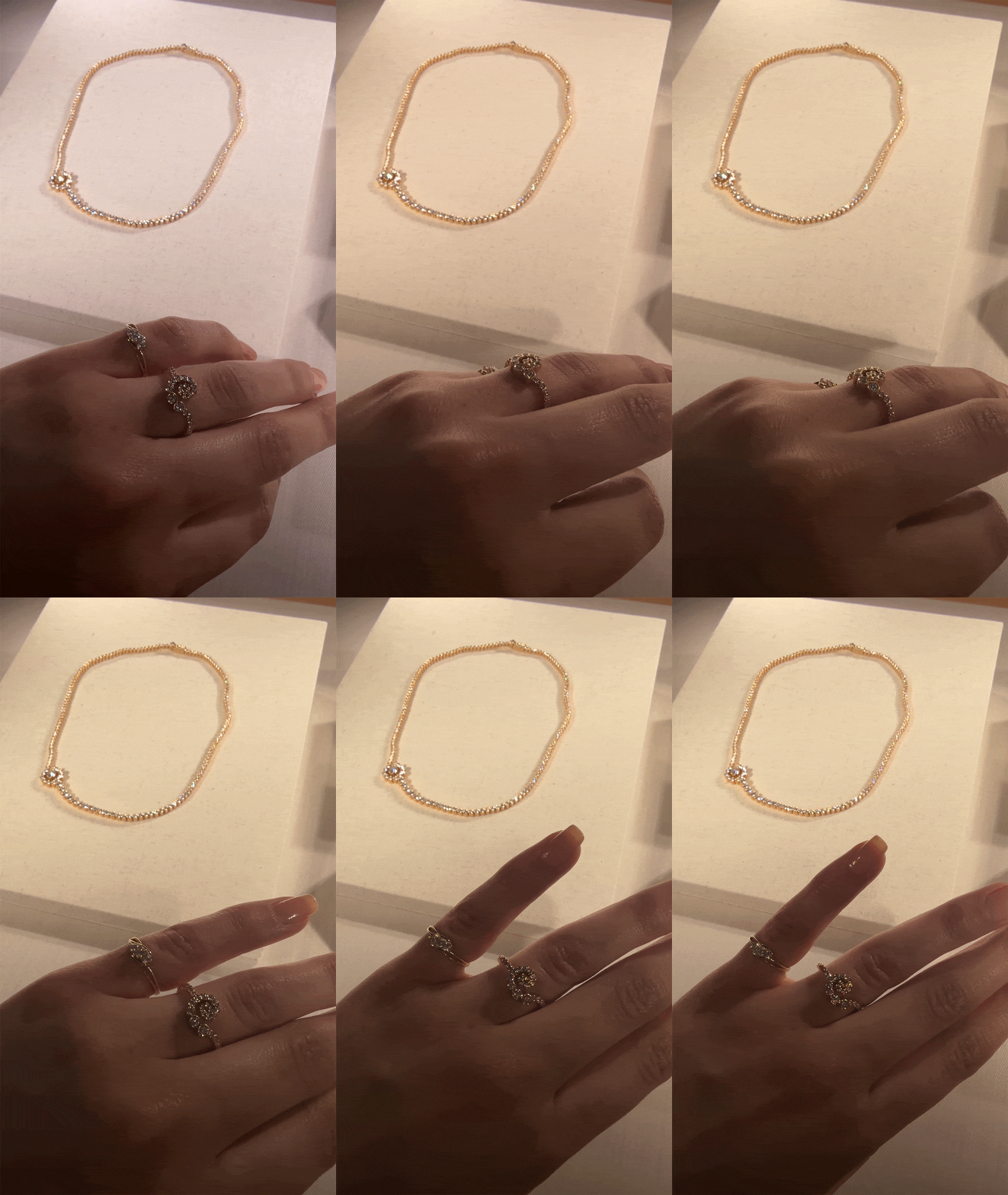
During my visit to the new NYC boutique on Madison Avenue (a beautifully intimate and heavily curated space), I witnessed Brahe’s enigmatic whimsy. “My designs often begin with a feeling—something I sense but can’t yet describe,” said Brahe. The cascading pearls, architectural finishes, oceanic references, and sculptural diamonds are all conscious details designed to elicit emotion in the wearer. It only made sense when she told me how she spent her younger years encompassed by antiques and heirlooms, which she links to her "desire to create pieces that feel timeless."
Those who wear a Sophie Bille Brahe piece return because, as Brahe puts it, “they feel connected to the universe we’ve created. Each piece is designed to complement the next, so their collection becomes a personal narrative.” Brahe’s storytelling is evident throughout her work, from her Icon pieces, such as the Grande Ensemble Ocean ring, which she wears as a gift after the birth of her daughter, to her intricate pearlwork. For Brahe, purity and narrative are the emphasis: “How simply can you show a diamond, how clean can you show a pearl,” and how “when you choose something that resonates deeply, it becomes a companion, something you carry through your days and perhaps pass on one day.”


Kinn Studio
Jewelry is personal. To Brahe, it is “emotional.” To a fiancé, it is a declaration of love (both to the giver and the receiver). To Kinn Studio, it is an heirloom. “For us, jewelry isn’t meant to sit in a box waiting for a special occasion. It becomes meaningful through wear—through the life that happens around it,” said Kinn’s founder, Jennie Yoon. Yoon began the studio to re-create family heirlooms lost in a home robbery. Kinn’s beginnings touched me because, sadly, I share a similar story. My family originates from Cyprus, and much of my yiaya’s collection has been stolen. Years and years of legacy stones and generations of metalwork lost. The pain arises not from a monetary loss but from the loss of tangible artifacts of family history.

Kinn’s dedication to designing modern heirlooms is not only inspiring but also a solution for customers who want jewelry that feels heritaged. “A modern heirloom, through the lens of Kinn, is something that lives with you through different chapters of your life,” said Yoon. As my grandmother viewed her pieces, Yoon notes, “fine-jewelry collections are rarely built all at once.” Though, “a necklace is usually the easiest place to start, especially a simple gold chain that you never have to take off,” recommends Yoon. She pointed out the Mia and Matisse Link Chains as beautiful beginner pieces. “I also love suggesting a small pair of gold hoops or huggies—they instantly elevate whatever you’re wearing,” shared Yoon. Her recommendation: the Teardrop Hoop Earrings.
Kinn Studio recently celebrated the opening of an NYC flagship boutique in the West Village. I stepped into the space and instantly felt as if I had opened my grandmother’s jewelry box. If you find yourself on Bleecker Street, I suggest you pop in. Both Yoon and her sales staff are well-educated on the fine-jewelry space. I look to Yoon to weigh in on the lab-versus-natural discussion. Yoon answered with great nuance: “We offer both lab and natural diamonds at Kinn, and the right choice really comes down to what matters most to the client. Some people are drawn to the rarity and tradition of natural diamonds, while others prioritize size or budget, where lab diamonds can offer incredible value.”


Steph Mazuera
My introduction to Steph Mazuera was through Who What Wear associate features editor Ana Escalante. Here’s Escalante on her bespoke engagement ring from the designer: “I first discovered Mazuera through TikTok, and after she randomly messaged me out of the blue one day, showing me a picture of a diamond she saw she thought would be perfect for me, I was convinced. Mazuera ended up creating my engagement ring—a half-bezel bypass setting sculptured around a one-of-a-kind buttery-yellow pear-shaped diamond. Over the last few months, I've collected a few of Mazuera's diamond basic pieces for everyday use since I've fallen so in love with her designs.”

I met with Mazuera in her Downtown NYC office to discuss her new line of everyday diamond pieces—the Billie Tennis Bracelet, the Alpi Earring, the Arc Tennis Bracelet, and more—all of which are handcrafted in New York. Like Yoon, Mazuera encourages clients to start with the fundamentals. “I recommend starting with diamond studs or a classic tennis bracelet, pieces you can enjoy daily and use as the foundation for building an entire fine-jewelry collection,” suggested Mazuera.
Then, we touched on the delicate topic of lab-grown versus natural diamonds. Asking her to be succinct was difficult, given all its complexities. A bonus of Mazuera's consultation is her kind, educational tone and extensive industry knowledge. “There’s an undeniable romance to natural diamonds, formed over billions of years, but not every purchase needs to carry that weight. Lab-grown offers a more effortless way in while still being real and enduring, especially when sourced with the same level of care and quality as natural stones," shared Mazuera.


Dorsey
Dorsey deals only in lab-grown diamonds. I asked Meg Strachan, Dorsey’s founder, what is exclusive to the Dorsey buying experience. “We lead with design, not stone hierarchy, and [Dorsey sells] every lab stone from diamond to sapphire.” While "most heritage brands keep fine-jewelry aesthetics behind high price points, [Dorsey offers] the same design across multiple stones and metals, allowing the customer to choose how they enter the space.”

“Fine jewelry is an investment in the materials, but it’s really up to the customer and their budget,” clarifies Strachan. “A first-time buyer can start with high-quality lab-grown moissanite for a few hundred dollars or can opt for 14K gold and lab-grown diamond pieces.” Strachan goes on to note, “These stones are molecularly identical to mined counterparts.” As a first-time buyer myself, I can appreciate Strachan’s clear presentation of Dorsey's approach to the lab-grown conversation.
You’ll see that family is a common theme when talking about jewelry. Dorsey is no different. Here is Strachan's advice to shoppers: “Buy pieces that you’ll actually reach for every day. I always build my outfit around my jewelry, which is something I learned from my grandmother, Dorsey. She believed jewelry shouldn't be saved for a special occasion, and you should look for pieces that feel like an extension of your personal style.” She followed up with foundational pieces from Dorsey’s collection.


Aaryah
Aaryah is an investment in natural diamonds. I saw this firsthand in my visit to the NYC showroom. There, I met with Kothari. “I built Aaryah because the traditional jewelry experience often felt transactional, intimidating, and honestly very male-driven,” she shared. Her intention was to create a space that felt collaborative. “Everything we do is centered around the client—how they want to shop, what they’re celebrating, how they want to feel. Whether it’s online or in our NYC showroom, each private shopping appointment is curated and deeply personal.”

At the showroom, I tried on the BB Thelma ring. It is a pinky ring that features a pear-cut stone (your choice of sapphire, gemstone, or natural diamond—I personally love the look of a yellow diamond) in a bypass setting, available in yellow gold or platinum with a satin or high-shine finish. The fashion set loves the pinky ring for its retro origins and modern silhouette. Tastemakers from Nara Smith to Aimee Song can be seen wearing it.
In addition to her recommendations for a first-time fine-jewelry buyer—pinky rings, stackable bands, a unique pendant, and a diamond hand chain—Kothari shared her views on natural diamonds. “We ethically source our diamonds from places like Canada, which have stricter labor laws than the U.S.,” shared Kothari.


Blue Nile
“As the original online jeweler, Blue Nile was founded on the belief that exceptional quality should be accessible, transparent, and delivered directly to the customer,” said Katie Liappas, Blue Nile’s chief merchandising officer.

Blue Nile’s appeal lies in its authenticity and educational nature. With over 25 years in the fine-jewelry space, “through its Diamond and Jewelry Education resources, customers gain clear, practical knowledge to empower confident purchasing decisions,” explained Liappas. Offering both lab-grown stones and natural diamonds, “all Blue Nile diamonds are conflict-free and comply with the Kimberley Process, ensuring responsible sourcing at every step,” Liappas was proud to share. For first-time buyers or those unfamiliar with the Kimberley Process, it is a global initiative that began in 2003 to eliminate conflict diamonds from the supply chain.
When asked how to begin a fine-jewelry collection, Liappas said it's best to “start with the basics!” Her advice: “Invest in essentials that are timeless, versatile, and designed to last—your ‘little black dress’ of jewelry. Diamond stud earrings or a classic tennis bracelet pair with any look day or night—be it your favorite jeans or an evening gown—and serve as the building blocks of a collection you can grow over time.” That seems to be the consensus among the experts and jewelry designers I’ve spoken with. A collection is ongoing, but as with anything worth growing, the foundation is the most important step. Blue Nile is an approachable and accessible starting point.


Why Trust Us?
At Who What Wear, fashion is our speciality. Our editors have years of industry experience, from reporting on seasonal fashion trends seen at international fashion weeks to working with some of the most recognizable names in fashion. Every item we recommend is carefully selected based on current trends, quality, and real-world wearability.
We regularly try pieces ourselves, including everything from bestselling jeans to designer shoes, speak to external experts and fashion insiders, and stay closely connected to what our readers are searching for. Our advice is grounded in expertise and has to pass our exceptional taste levels—so you can feel confident in every recommendation.
This article was previously published and has since been updated.
