Andrew Garfield Wants to Speak to Your Soul
From a period piece to a hypermodern tale of technology, the decorated actor stretched himself across millennia last year. In 2026, he's looking forward (and inward).


Andrew Garfield is having a "weirdly unbusy" day, or so he tells me when he phones in from the grocery store, where he's doing his post-flight foraging. He's just returned from a trip to New York, packed with downtown sushi spots (he recommends Bar Miller), Cats: The Jellicle Ball ("Have you seen it? You gotta make time for it," he says after I tell him I live here), aimless Central Park strolls, and press-junket stops. "Can you hear me okay? You're catching me in transit a little bit, so if things get cut out… I just landed on a plane to L.A.," he says in a flurry of apologies, somehow made sophisticated by his velvety British accent. I assure him I can hear him just fine and that I understand the need to multitask. He's on a generational run, after all.
Garfield just wrapped his stint as Roy Horn, one half of the Las Vegas big-cat magician duo Siegfried & Roy, in Apple TV's Wild Things, which will debut in early 2027 (hence why his hair is now chin-grazingly long). His NYC trip included pit stops at news outlets and magazine headquarters to promote The Magical Faraway Tree, a fantasy film in which he stars alongside The Crown's Claire Foy, and now he's preparing to take on the press gauntlet of his two upcoming projects: Paul Greengrass's The Uprising (I'd just white-knuckled my way through an early viewing) and Luca Guadagnino's controversial Artificial about OpenAI CEO Sam Altman, which comes out later this year.

I've always been drawn to Garfield's interviews just as much as his work. Whether I was reading a beautifully built profile about his worldly musings or watching a 15-second video clip, the 43-year-old actor is a gravitational force. Los Angeles born and Surrey grown, the star flits effortlessly between cracking brain-rot jokes ("I'm aura farming," he very Americanly tells a confused Foy in Vanity Fair's Lie Detector Test), dodging compliments (very British), and philosophizing about the world as he knows it and the role he plays—both literally and figuratively. With bookish charm and deep, knowing eyes that silently tell you he understands, Garfield cleaves open conversations about the mundane until the core matter spills out. He's heartbreakingly raw about grieving his mother, Lynn, whom he lost to pancreatic cancer in 2019. When asked about The Social Network and Artificial, he champions the human shrapnel wrought by power-hungry tech oligarchs. In 2026, he's still touched by the fact that he has "any association at all in anyone's consciousness" with Marvel's Spider-Man. In short, he's helplessly allergic to small talk. He'd rather get down to the stuff that matters.
He's making his way through the aisles now, which I can only tell because our conversation is peppered with—but never disrupted by—polite "Excuse me!"-s and "Pardon me"-s. "I love New York," he tells me, a smile staining his voice. "Whenever I'm there, I'm just very happy." It makes sense, seeing as he spent years in the Big Apple while filming The Amazing Spider-Man franchise and the award-winning musical Tick, Tick… Boom! and performing on Broadway in Death of a Salesman and Angels in America, the latter of which earned him a Tony. After this laundry list of critically acclaimed projects that occupy just a fraction of his IMDb page, it shocks me that the A-lister still runs his own errands. But his ability to simultaneously and thoughtfully delve into the throes of his upcoming films informs me of three things. One, Garfield really is all the good things you hear about him from fans and industry insiders alike. Two, he has the distinct and deeply endearing ability to turn his to-dos into the backdrop for thought-provoking conversation. Three, stars, they really are just like us.

It only takes a few minutes of casual conversation with the veteran Spider-Man to realize why something as simple as an errand run is so high on his priority list. It's the same reason why he finds himself drawn to the sprawling grounds of Central Park and why he told Esquire UK Editor in Chief Teo van den Broeke that he giddily agreed to snap a shot of two oblivious girls at Glastonbury when one handed over her phone—not for a selfie, but for him to capture them on the festival grounds. You see, after more than 20 years in the industry (and becoming an award-winning actor at the 2008 BAFTAs for his lead role in Boy A at just 24 years old), Garfield is all too used to the impromptu photo ops, burning spotlights, and ceaseless media attention that comes with fame. While most fresh-faced 20-somethings a few years post-grad are running up tabs at pubs, navigating new careers, and maybe still living at home, Garfield was dipped in Hollywood gold and subsequently thrust into the very scrutinizing public eye. So when he gets a chance to meander about the aisles, fade into throngs of NYC tourists, and be the nameless photographer behind an Instagram shot, he can finally breathe.
It's these rare moments of blissful regular-personhood that he has chased over the last year while wrapping consecutive projects and pouring his blood, sweat, and tears (literally) into The Uprising. It's the snippets of normalcy—like time spent with his nephews and the serenity of meals cooked at home—that he holds dear, but while his idea of heaven has graduated from glittering awards to quiet nights at home with a good book, that's not to say his ambition has taken a back seat. In fact, The Uprising adds an impressive new notch to Garfield's belt and tells a story just as profound as the ones padding his personal library.

After long pining for a chance to work with Greengrass, the director behind blockbusters such as The Bourne Ultimatum and harrowing action films like United 93, Garfield clinched the role of Ploughman in The Uprising, which premieres on September 11. "He's on that very short list of filmmakers that I've longed to work with," Garfield says of the project's spearhead. In it, Garfield portrays a farmer-turned-insurrectionist who incites the Peasants' Revolt of 1381 against King Richard II—a true story of rebellion instigated by the Crown's tyrannical taxes on England's working class, cruel labor laws, and residual tensions from the bubonic plague. Within the first few scenes of the film, Garfield's character gives the name "Ploughman" to a corrupt tax collector with a simple explanation: "I am what I do." As it turns out, this plain introduction is one the actor could have used himself over the course of his abundant career.
Having started acting professionally at age 21 after graduating from the Royal Central School of Speech and Drama in London, Garfield has a longer career than the years of his childhood and adolescence combined. He compares his relationship with his vocation to "standing on a seesaw." In a healthy way, the act of storytelling feeds his spirit. "In an unhealthy way, I don't know who I am unless I'm making things that feel expressive of my own soul," he says pensively. "I think that there's something beautiful about that level of devotion. But there's also a dark side to it."

Choosing a project and inviting new characters in requires a hard-earned level of discernment that Garfield has honed over decades in the industry. But when the star read Ploughman's story, he didn't just realize it was a good fit. The cultural relevance hit him squarely in the chest. "There was something universal in what the character and these people are going through, which is the question of, What happens to the human soul when it's pushed beyond what it can take?" he muses. "The feeling of 'Either things change, or today is a good day to die'—how do you get to that place?"
This level of introspection is normal for Garfield. Sure, he admits that he was partially attracted to the story due to its connection to his own ancestry (his maternal heritage comes from Essex, England, where much of the Peasants' Revolt began), but what he couldn't escape was the stark parallels in disenfranchisement between two eras separated by a millennium.
"It doesn't get any more profound than that—when the human soul is treated with such a lack of dignity. And we see it around the world right now," he says solemnly. "I'm so fascinated by what it is to be in a revolution. Can you have a revolution without violence? Is that possible? Is that naïve?" These weren't just questions Garfield asked himself as he prepared to take on the role of a poverty-stricken farmer beaten down by life and loss. They're also questions worth considering with every newscast and war update today.

This is evident in a live taping of writer Josh Horowitz's podcast, Happy Sad Confused, in 2024, where Garfield called for the support of Palestinians amid the ongoing war in Gaza. The actor has also voiced concern about Donald Trump throughout his tumultuous terms as President of the United States, critiquing humanity's general inability to be honest about the bad parts of themselves and the inclination to engage in celebrity worship—a camp in which he's included himself.
"Look who's in the White House. It's an idiot celebrity, and we enabled that. It's not just the people who voted for him; it's the whole culture. We started worshipping things that are empty and false, and you know, here we are," he stated in a 2017 interview with The Times. He spoke openly in a recent interview with Esquire UK about the perils of confronting the unconscious "shadow self," per Carl Jung, and how we all could use a bit more of these ugly self-assessments—especially when it concerns government authority. "But then the argument is that if we weren't all less rejecting in the first place, less 'That's not us,' then Donald Trump wouldn't have been voted in twice, and Nigel Farage wouldn't be anywhere near a position of power," he told Esquire. It's a tale as old as time, Garfield tells me, as he details how 14th-century commoners regarded then-14-year-old King Richard II as a "conduit for God"—and Lord help anyone who went against him. It's a soft reminder that this story, and its bloody message, isn't an ancient one.
"That kind of prevailing attitude is going to keep people so scared of stepping out of line," Garfield explains. "It's an incredible tactic of oppression and fear-mongering." When our modern-day news often reads like an AP world history textbook, the star found this narrative imperative to tell and be heard on all sides. "It feels like a really important story now for all of us to reckon with, no matter where we are on that spectrum—whether we're benefiting from a system of oppression or not," he continues.

The range of emotions Garfield and his castmates display in this film radiates off the screen, permeating the room in hair-raising ripples of fury, heartbreak, and hope. He likens soft moments of dialogue to the sanctity of prayer and says those rare moments of stoicism required a special kind of presence on set. "It takes concentration, preparation, and then a lot of surrender," he states, emphasizing the importance of "letting go" not just in the filming process but also in the project as a whole.
While his gut-wrenching performance in The Uprising is a testament to Garfield's prowess, the actor's personal experiences also quietly shaped the character. "As an actor, the raw material of what you're using is you," he explains. Ploughman's grief over the loss of his family, taken in one fell swoop by the bubonic plague, runs parallel to his own grief following the death of his mother. He was incredibly vulnerable about this world-altering event in a 2021 appearance on The Late Show With Stephen Colbert, in which he touched fans' hearts with his wisdom on life after loss. "We never get enough time with each other, right?" he told the attentively listening host. "So I hope this grief stays with me because it's all the unexpressed love that I didn't get to tell her." In 2026, he credits the film's overarching theme of surrender to loss—and, more notably, how one continues on after waving the white flag—as what made the experience so transformative.

"I think about when my dad went bankrupt, and he realized that he was still loved. His big fear happened, and he realized, 'Oh, I still have my family. They're not going anywhere,'" he says, pausing in a moment of reflection. "I think there's something quite profound—and difficult, of course, but very beautiful—about entering that very raw space of having nothing to lose."
Garfield understood that it would take some world-building to ease himself into the smoggy atmosphere of 14th-century England, especially since he'd completed his stint as the temporarily ousted Altman just two weeks prior. I call that transition whiplash; he laughs knowingly. There's something almost biblical about going from a film called Artificial to a story that's so human, I add. "It feels like the two extremes of what it is to be a person," he agrees.
Music played a vital role in Garfield's transformation during that two-week intermission, which is unsurprising for someone who started their career in theater and dabbled in musicals like Lin-Manuel Miranda's Tick, Tick… Boom! "I was listening to a lot of songs of revolution, like Nina Simone and Billy Bragg," he explains, "but I was also listening to a lot of English folk music." Perhaps he was directly referencing the upbeat outcries of Simone's "Revolution, Pts.1 & 2" or Bragg's "Take Down the Union Jack," but something in these sonic cues inspired a spiral about what it actually means to be English. "Is there such a thing as being indigenous to the United Kingdom? And what's the indigenous spirituality? It's not Christianity," he says in a bubbling stream of consciousness. While he may not have all the answers now, he knew one thing to be true by the time he wrapped The Uprising: Given the choice between being a battered revolutionary and becoming a tech leader, he'd choose the former. "It was much more pleasurable being part of the Peasants' Revolt in medieval England, which says something, I suppose," he laughs.

You see, Garfield desires to immerse himself wholly in the psyche of the characters he plays—to adopt their mannerisms, understand their thoughts, and embody their essence until the lines between self and subject blur. Usually, this leaves the actor with a sense of understanding, even if the character has a villainous streak. But after playing the role of Altman in the summer of 2025, Garfield walked away from the project more confused than ever before.
"I really wanted to understand what it takes to 'win' at that level—what you have to sacrifice," he explains. "When you're at the forefront of creating new technology—the human costs, the people losing their jobs—what does it take to keep moving forward, knowing it's part of what you're creating?" It's a question that's lingered in Garfield's mind since taking on the role of Eduardo Saverin, the ejected cocreator of Facebook with Mark Zuckerberg in the 2010 film The Social Network. "I think I was playing the more human person in that relationship by playing Eduardo," he speculates. "It left a kind of unmet curiosity in me that was dangling around—like, 'Ah, fuck! I still want to understand what it takes to win'—because Eduardo famously didn't 'win' the capitalist game in that particular moment."
This fascination didn't stem from any desire of Garfield's to adopt a tech-bro mindset, per se. Rather, he craved the chance to explore a spirit so opposite to his own. Ask, and you shall receive. Nearly 15 years after The Social Network debuted, a script for Guadagnino's film about Altman, a satirical Silicon Valley film for the modern day, came across Garfield's desk. But what he found on the other end—the "winning" end—was a dull emptiness that couldn't be filled with material things or excessive liquid assets.

Recently, the film has been shrouded in some controversy. Its original distributor—Amazon MGM Studios, which has invested in OpenAI—dropped the project. It was later reported by Deadline that Neon acquired U.S. rights to the film. It's also worth noting that the AI giant has no connection to the project, and Garfield and Altman have never met. Though Garfield admits to having "a lot of very healthy fear" around taking on the character, he figured he'd discover Altman's essence somewhere along the way. "I'm a competitive person!" he exclaims, trying to find a semblance of common ground. "I love games. I love sport. I love winning. But winning at all costs in that world feels dangerous to the soul and, maybe more importantly, dangerous to the world."
A summer in Altman's shoes passed, and Garfield closed out his second film about big tech with more questions than answers. "I can never know the inside of [Altman's] head or the inside of his heart," he says diplomatically. "But I still remain very, very curious about what part of yourself you have to access, or maybe dissociate from, in order to achieve what these mostly men can." He uses the word "achieve" quite loosely. "It's fascinating to me as maybe someone who's too bleeding-heart."
It's this heart that has felt the disorienting effects of filming emotionally heavy projects in such close succession, but Garfield credits his costars and directors as driving forces behind the positive experiences within such "profound and challenging" films.
"Luca is someone who's so artistically free and kind of radical and punk," he rattles on about his Artificial director. "He just cares about expressing himself in the purest way possible, which I find deeply inspiring."

When speaking about Artificial costar (and girlfriend) Monica Barbaro, there's reverence in Garfield's tone. "I think Monica is a supremely talented actor," he starts. Fresh off a successful few years of high-profile films like Top Gun: Maverick, A Complete Unknown, and, most recently, the rom-com One Night Only with Callum Turner, Barbaro joins Garfield as former OpenAI Chief Technology Officer Mira Murati, and he isn't shy about commending her portfolio of work. "I think what she did as Joan Baez [in A Complete Unknown]—what she accessed in that project—is nothing short of transformational, extraordinary, and deeply mysterious," he continues. "I think she is truly incredible. I could wax lyrical more, but I'll leave it there."
For The Uprising, he commends Thomasin McKenzie's "pure and soulful" demeanor and Jamie Bell's performance, which he lauds as "so fierce and rageful in its purity." With boyish joy, he shares that "[Greengrass] is the kind of person that you want to get covered in mud and go sprinting take after take for, to the point where you might vomit."

Garfield jokes that balancing several projects in quick succession felt "a little bit like Robert Downey Jr. in Tropic Thunder, when he's gone from character to character and has no idea who he is." Though these upcoming films are the topic of much intrigue, all roads lead back to his stint as the Amazing Spider-Man from 2012 to 2014—a role he reprised alongside Tobey Maguire and Tom Holland in the 2021 installment Spider-Man: No Way Home. "I'm grateful for the connection to a character that may be one of the most beloved fictional characters in the modern world," he says humbly. He holds in high regard the fact that anyone—regardless of skin color or gender identity—can project themselves into the suit. "I find it very moving that I have any association at all in anyone's consciousness with the ultimate beautiful, human, 'trying to do good' character," he beams. "I kind of can't believe that I had the chutzpah to even try to be part of that, but here we are." He continues, laughing at his own audacity, "I feel very, very lucky."

With numerous projects wrapped and a flurry of press junkets looming over the horizon, Garfield is enjoying the present, but that doesn't mean his mind never strays toward the future. He tells me of his "definite desires" and "vague plans" to return to the theater after his last run in Angels in America in 2018, though he's tight-lipped about specifics. "I'm always, God willing, going to be able to make theater," the actor muses. "That's where I feel most purposeful. … It's the place where I feel most happy and connected to that mysterious 'thing' that's bigger than me, that I get to give myself, my energy, and my love to. I feel I can make a difference in that space in a way that I can't anywhere else."
Though there's no telling when Garfield will return to the stage, the actor still feels there are hidden opportunities coming when he asks the universe what else is out there for him. "I'm wondering 'What do I do now?' in a way that feels very possible and exciting," he imparts, emotion lapping at his words. "I hope to bring new things into the world that haven't been done before—things that feel alive and, hopefully, healing for people, like an awakening of their own souls [and] of their own wrongings and desires and stirrings."
He's nearing the checkout line now, and I can only imagine what the cashier must be thinking as Garfield muses about one's unending search for self between pleasantries and passed produce. But that's the thing about Andrew Garfield: He knows how to turn the mundane into a masterpiece. "I just want to be of service through storytelling," he concludes.
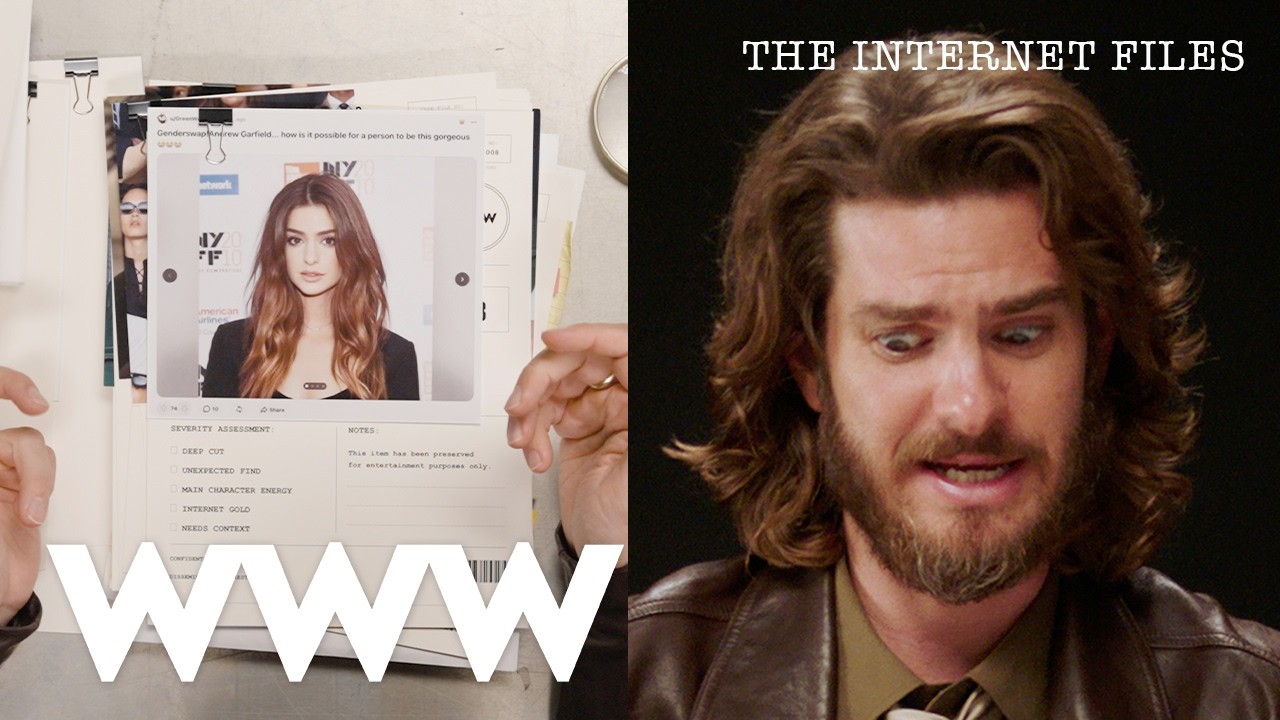
In "Internet Files," Garfield is wearing a Giorgio Armani jacket, Michael Kors shirt, and Louis Vuitton tie.
Photographer: Emmanuel Sanchez Monsalve
Stylist: Jake Sammis
Groomer: Christine Nelli
Editor in Chief: Kat Collings
Creative Director: Amy Armani
Set Designer: Lizzie Lang
Entertainment Director: Jessica Baker
Producer: Erin Corbett
DP: Kyle Hartman
Shop the September Cover Story


